Yes, you can systematically increase your farmers' market sales. The path runs through three phases: preparation before market day, a branded booth that invites people in, and active engagement while customers are standing in front of you. University extension programs and experienced market operators lay out the same core tactics, and this guide turns them into a repeatable checklist you can use every week.
Introduction: Your Farmers' Market Advantage
Not all markets are the same, and choosing the right one shapes everything that follows. Colorado State University's Extension office advises comparing location and foot traffic against your target audience, and weighing booth fees, required permits, and market regulations before you commit. A market that fits your customers is worth more than any display trick.
Once you're in, treat market day as a system rather than a series of improvisations. Penn State Extension's market guidance and CSU's vendor guide both describe the same pattern: vendors who prepare thoroughly, present well, and engage actively outsell those who simply show up with product. The rest of this article walks through each phase, then closes with a low-cost marketing plan built around Instagram, storytelling, and vendor networking.
Phase 1: Pre-Market Preparation Checklist
Start with legal compliance, because it gates everything else. Market rules like those adopted by the Nashville Farmers' Market require vendors to inform themselves about and comply with all regulations governing their business, including the production, packaging, labeling, display, distribution, sampling, and sale of their products. Vendors there must also maintain all required licenses, permits, and certificates and pay applicable taxes and fees. Requirements vary by jurisdiction, so check with your own market and local agencies before your first day.
Some products carry extra requirements. Penn State Extension notes that if you use scales, they must be certified by a weights and measures authority, such as Pennsylvania's Department of Agriculture or your county department. Food vendors should expect health department permitting and possible inspections, though the specifics vary by location.
Then prepare product and pricing. CSU's guide warns that the biggest pricing mistake vendors make is not fully understanding their costs, which leads to prices set too low and working for pennies. Customers are often willing to pay more for high-quality local products, so don't undervalue your work. If your product is unique or organic, you may be able to emphasize quality and charge a premium.
Phase 2: Booth Setup & Display Essentials
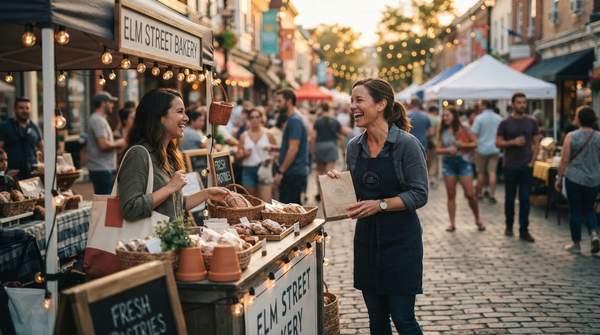
Your booth is your storefront, and how you present products plays a huge role in attracting customers and making sales, according to CSU's guidance. Branding is the first step Penn State Extension lists among its market-day "do's": brand your stand so shoppers can find and remember you.
Practical merchandising standards from the Nashville Farmers' Market's vendor handbook give concrete benchmarks. Vendors there are expected to maintain professional merchandising by using tablecloths, properly disposing of waste, displaying prices, and securing merchandise and decorations so they won't blow away. The handbook also suggests using as much table frontage as you can, and—if you have an established customer base—renting a corner space, adding a stall, or setting up in a U-shape to maximize merchandising area.
Timing matters as much as layout. Penn State Extension's advice is blunt: be on time. Setting up a stand takes a while, and if you arrive late and aren't fully set up when the market opens, you never will be—which can cost you sales income.
Phase 3: During-Market Engagement Tactics
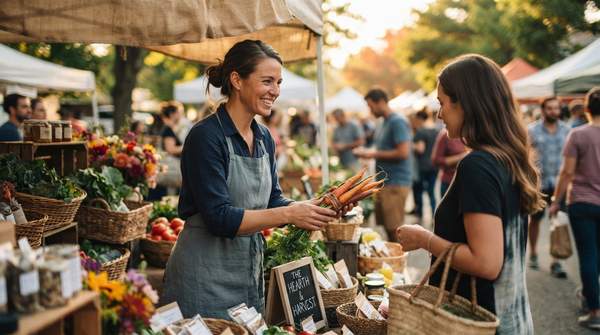
Once the market opens, your job shifts from logistics to connection. Penn State Extension's market-day guidance emphasizes being friendly and approachable: smile, greet customers, and offer samples to encourage interaction. Engagement is what turns browsers into buyers.
Storytelling is your differentiator. The Hollywood Farmers Market in Portland asks first-time vendors to consider what sets them apart and share it with customers: What do you love about your products? What do you grow best? Do you have products no one else has? What special knowledge can customers get from you and only you? Answering those questions out loud, at the booth, gives shoppers a reason to buy from you rather than the next table.
Product quality supports the story. The same market's vendor tips emphasize harvesting at peak, selecting varieties for taste and appearance, and displaying clean product beautifully. CSU adds that what you learn while selling can help you break into other sales channels that may be a better long-term fit.
Low-Cost Marketing Strategies for Farmers' Market Vendors
Marketing doesn't require a budget—just consistency. For social media, focus on Instagram, where a simple weekly rhythm works. Marketing writer Evan Knox, on the Homegrown blog, recommends posting a photo on Thursday or Friday showing what you're bringing to market, with a short caption covering what it is, where you'll be, and what time. Mention anything new or limited, include local hashtags, and tag the farmers' market account. On Saturday morning, post a Story when you arrive or while setting up, and add another mid-morning if something is selling fast.
Timing beats follower count. Knox argues that even 100 local followers can drive meaningful foot traffic, because what matters is that followers are local people who can actually visit you on Saturday. A vendor with 200 followers in their city will see more real-world results than one with 2,000 nationwide. The exact posting hour matters less than the day: people make weekend plans Thursday and Friday, so your post lands at the decision-making moment.
Finally, network with the people around you. CSU's guide stresses that being open to learning from fellow vendors, market organizers, and seasoned business experts plays a major role in your success. The connections you make as part of a local market are a resource in themselves—experienced neighbors can tell you what sells, what prices hold, and which market days are worth the fee.
Your Farmers' Market Success Checklist
The table below pulls the tactics from each phase into one operational plan you can run through before every market day, from legal groundwork to closing-time engagement.
| Phase | Key Action | Specific Tactic | Benefit |
|---|---|---|---|
| Pre-Market Preparation | Legal compliance | Obtain the business licenses, permits, certificates, and tax registrations your jurisdiction requires; certify scales if you use them; expect health permitting for food, which varies by location | Keeps you legally operating and ready for inspections |
| Pre-Market Preparation | Product & pricing | Know your full costs, price for quality rather than undercutting, and prepare products, packaging, and clear displayed prices | Avoids working for pennies and supports premium pricing for unique goods |
| Booth Setup | Visibility & branding | Arrive on time, brand your stand, use tablecloths, display prices, secure decorations, and maximize table frontage | Attracts attention and makes you easy to find and remember |
| During-Market Activities | Customer engagement | Smile, greet shoppers, and offer samples to invite interaction | Turns browsers into buyers and builds rapport |
| During-Market Activities | Product storytelling | Share what you love about your products, what makes them unique, and knowledge only you can offer | Creates a memorable experience that differentiates your table |
| Marketing Strategies | Social media | Post an Instagram photo Thursday or Friday with what you're bringing, your location, and market tags; add a Story Saturday morning and mid-morning | Drives local foot traffic at the moment shoppers make weekend plans |
Use it as a repeatable routine: run the pre-market rows in the days before each event, the setup rows before the opening bell, and the engagement rows throughout the day. The checklist is deliberately jurisdiction-neutral on legal items—your market's vendor handbook and local agencies define the exact permits you need.
Maximize Your Market Day: A Path to Repeat Customers
Implement a systematic approach to farmers' market participation, focusing on thorough preparation, engaging booth presentation, and proactive customer interaction. That is the through-line in every source here, from Penn State's market-day do's to CSU's eight-step guide: preparation, presentation, and engagement compound into loyalty.
Track your progress with a measurable indicator: increased customer engagement at the booth, higher sales volume, and repeat customer interactions over consecutive market days. Watch for the shopper who came because of your Thursday Instagram post, the one who asks about your story again, and the one who returns two Saturdays in a row. Those are the signals your system is working.
Sources
- 8 ways to make more money at a farmers market - Colorado State University — Office of Engagement and Extension
- Tips For First Time Vendors — Hollywood Farmers Market — Hollywood Farmers Market | Portland OR
- Do's and Don'ts for Selling at Farmers Markets — Extension
- Nashville
- nashvillefarmersmarket.squarespace.com
- Instagram for Market Vendors: 7 Post Types That Sell — Findhomegrown